bookmark_borderSilk Sageo Cord

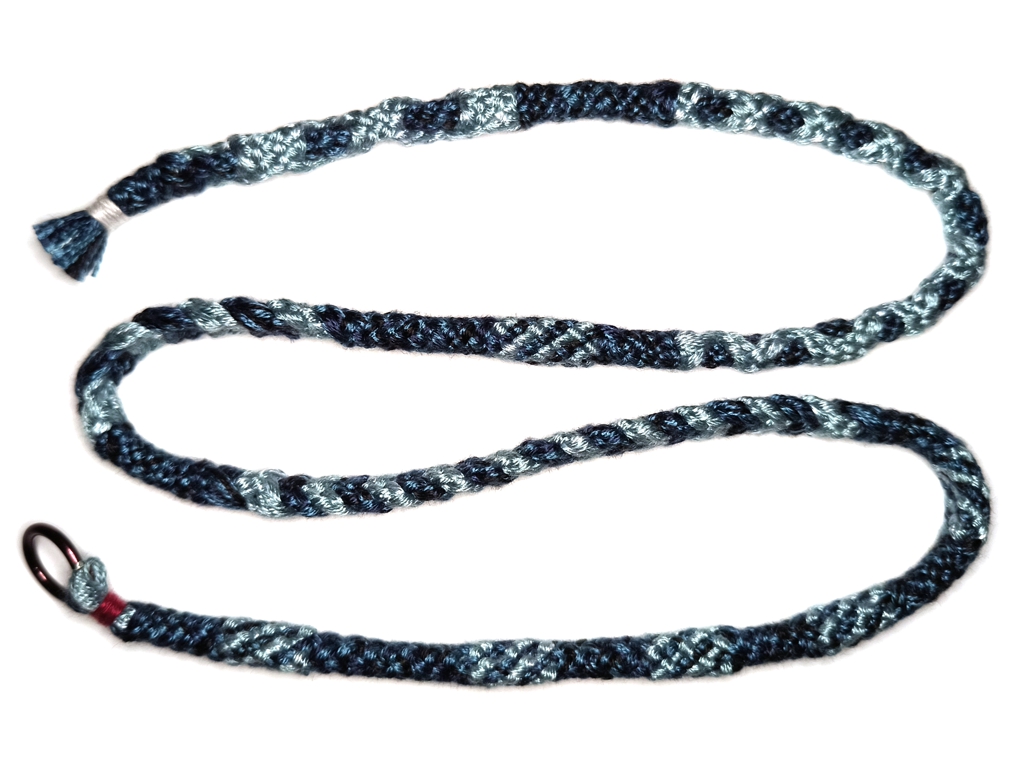
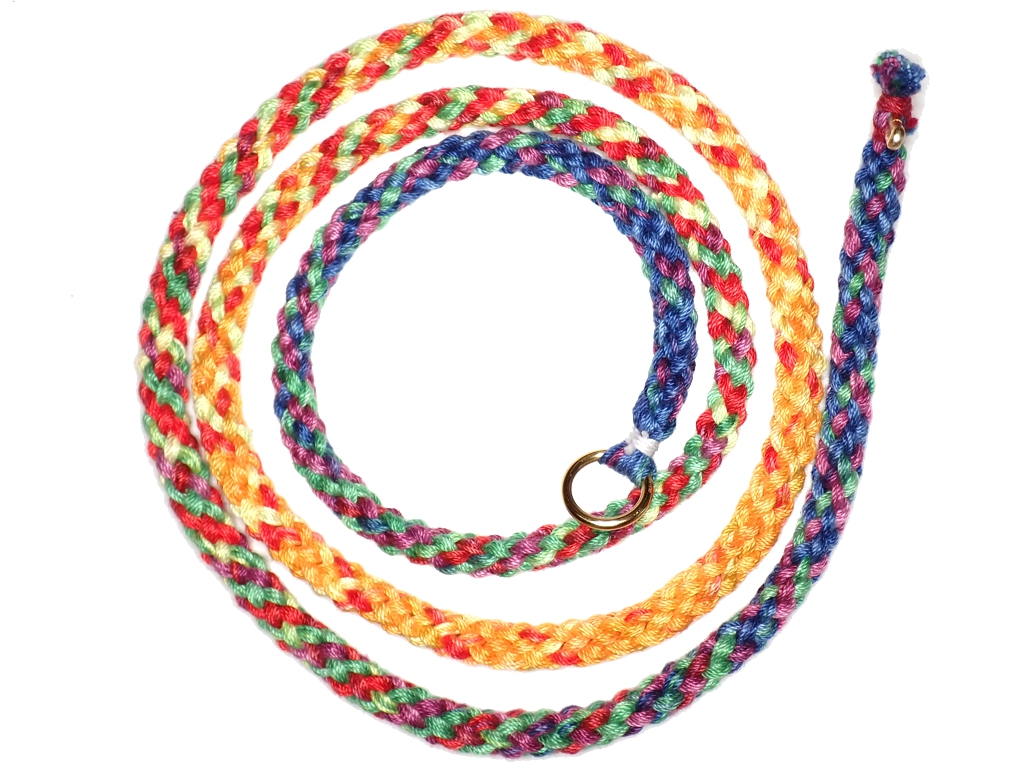
A dear friend of mine from way back who is a martial arts enthusiast had bought himself a Japanese sword, and he asked me if I would make a sageo cord for it. It was my pleasure to do this for him. I was able eventually to find some dark blue silk yarn in sufficient quantity to make this 9.5 foot long 7/16 inch wide 9-strand shigeuchi braid.

9-Shigeuchi Sageo in Silk

I started with about 13.5 feet of material, 10 ends of silk yarn per strand, and worked this braid on my sankakudai. Quite a bit of uptake, really. The amount of material gave me a nice heavy braid, and the silk makes it soft and flexible for its tightness. The use of yarn makes the braid a little fuzzier than I would prefer, but it’s mostly clean and only a little fuzzy. It took me about a year to get all my ducks in a row on this one, but like I said, eventually.

bookmark_borderRecent Spectral Braids

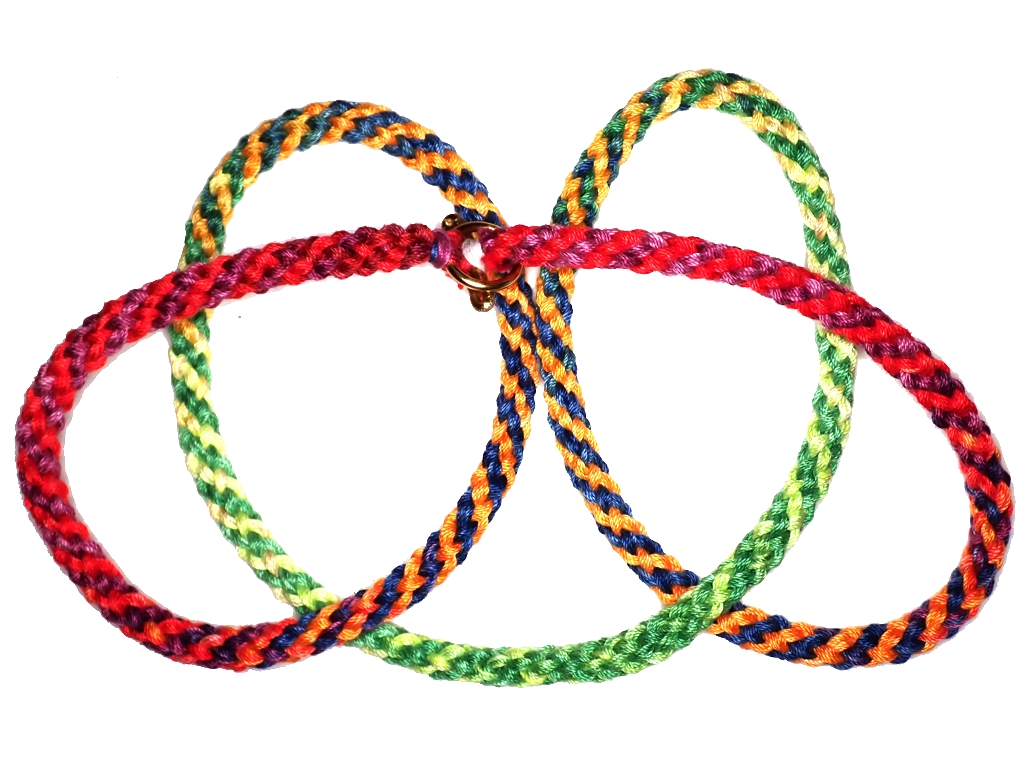
Given all of the “rainbowbraids I have done in the past year, and how the colors for our local SCA Barony are black and gold (just like Pittsburgh), we were beginning to run low on yellow cotton crochet thread. Normally, I would pop over to one of the local JoAnn Fabrics locations, but RIP JoFab. I hate mail ordering something I could just buy in a store, so I held my nose and went over to the closest Michaels. They actually had one package of the Aunt Lydia’s Classic 10 in yellow. It wasn’t the yellow I wanted (I prefer the deeper, more golden yellow to the more pastel yellow.), but it was the same as what we had a bit left of, so that was OK.

They also had some of the rainbow variegated thread, so on a whim I bought some and tried to measure out some warps that matched the progression of colors across the plies in each strand. Then I braided the edo yatsu gumi with each to see what effects I could create.

Edo Yatsu braid in Variegated Cotton

The first try I didn’t get the length of the warps quite right. Plus, because of the way the yarn is wrapped back and forth between the warping pegs, half the warps have the color progression reversed. Still an interesting braid.

Edo Yatsu braid in Variegated Cotton

On m second try, I got the warps about as close to perfect as I can imagine. Still, because of the reversed warps the spirals cancel out in the middle and it’s an almost solid green.

Edo Yatsu braid in Variegated Cotton

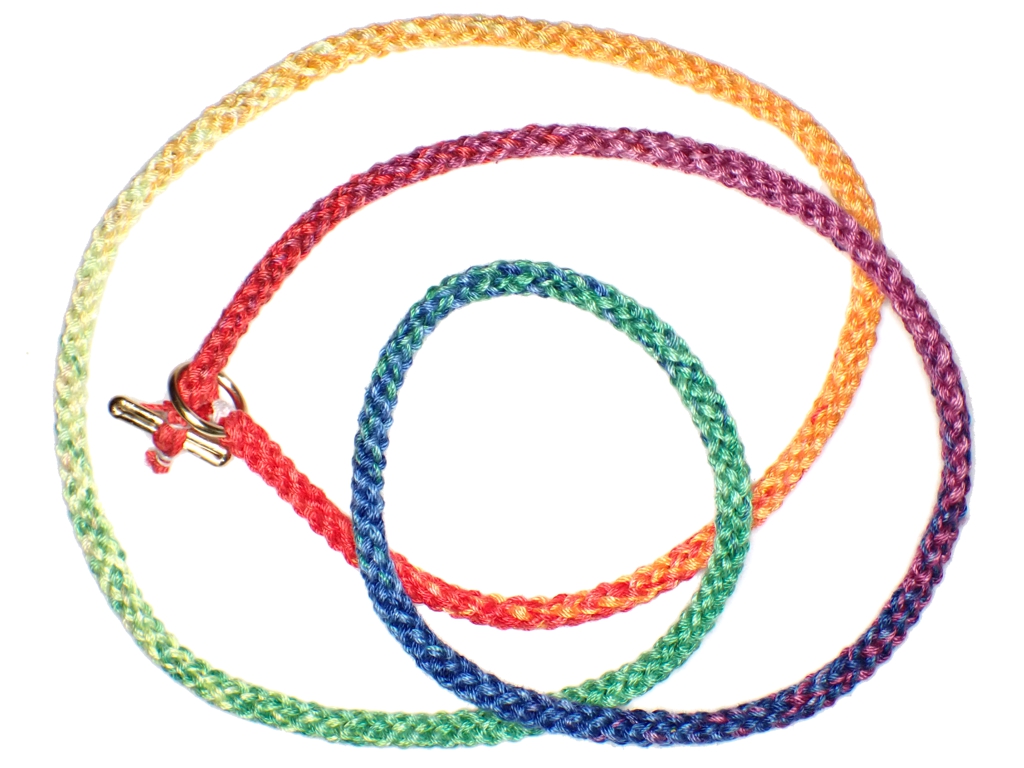
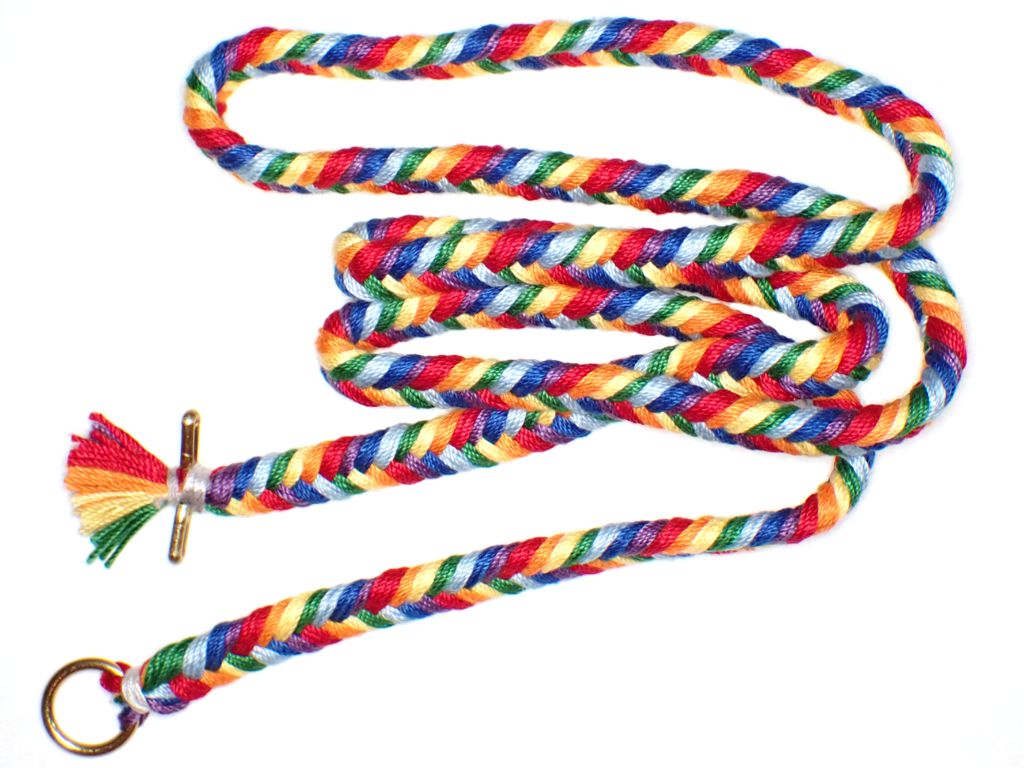
Finally, I gave in and cut the warps, matching them end for end. I still used the same edo yatsu braid as the first two, but I only used 6 plies of cotton per strand instead of 8. This results in a slightly thinner braid, and the color matching provides a much smoother fade from color to color down the braid. I really like this one.

I’ve done so many longer and more complex braids lately that I have almost forgotten how much fun it can be to quickly warp up a shorter, simpler braid and have a completed cord in an hour or so.

bookmark_borderTwo-color Sankakudai Braid

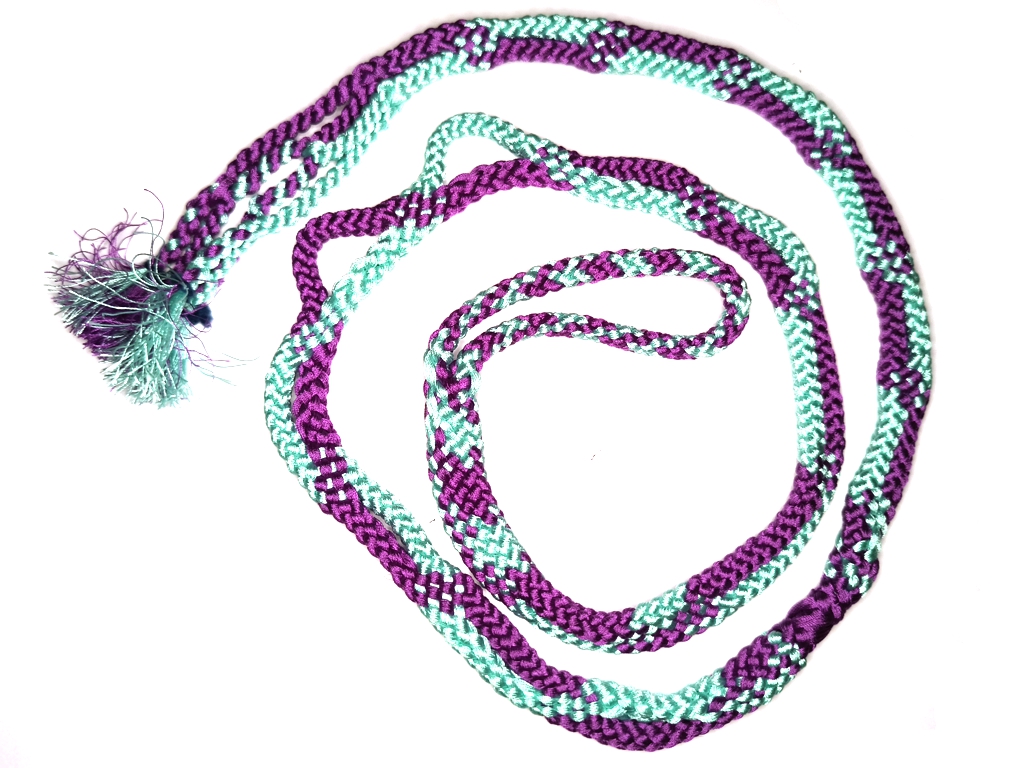
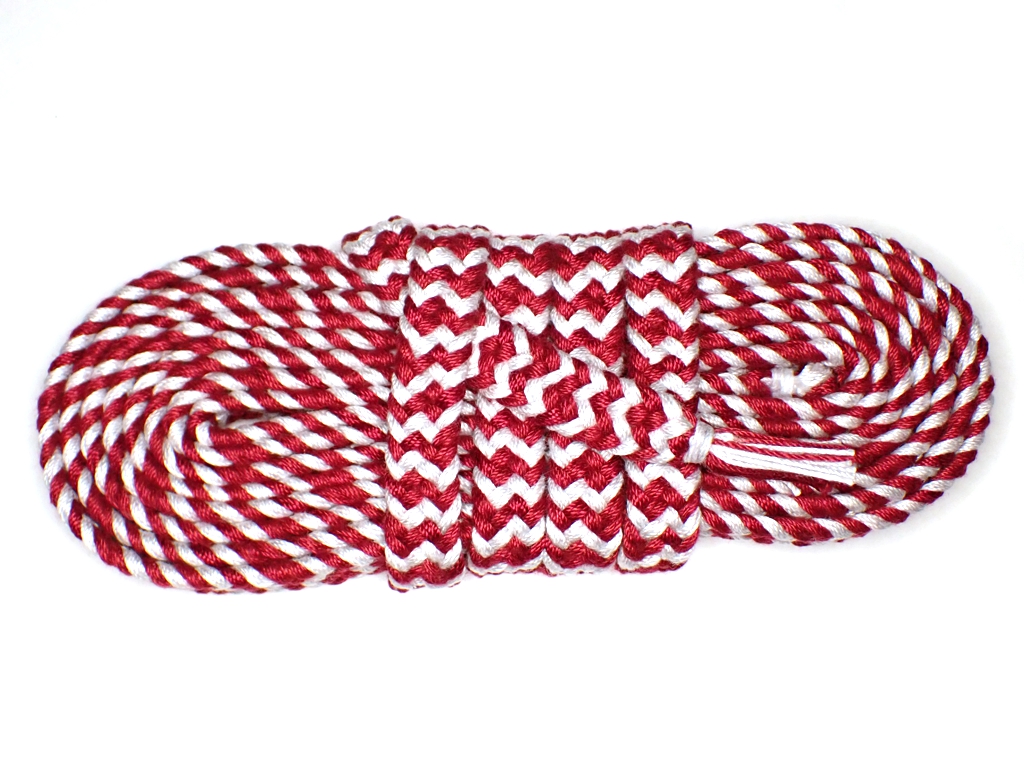
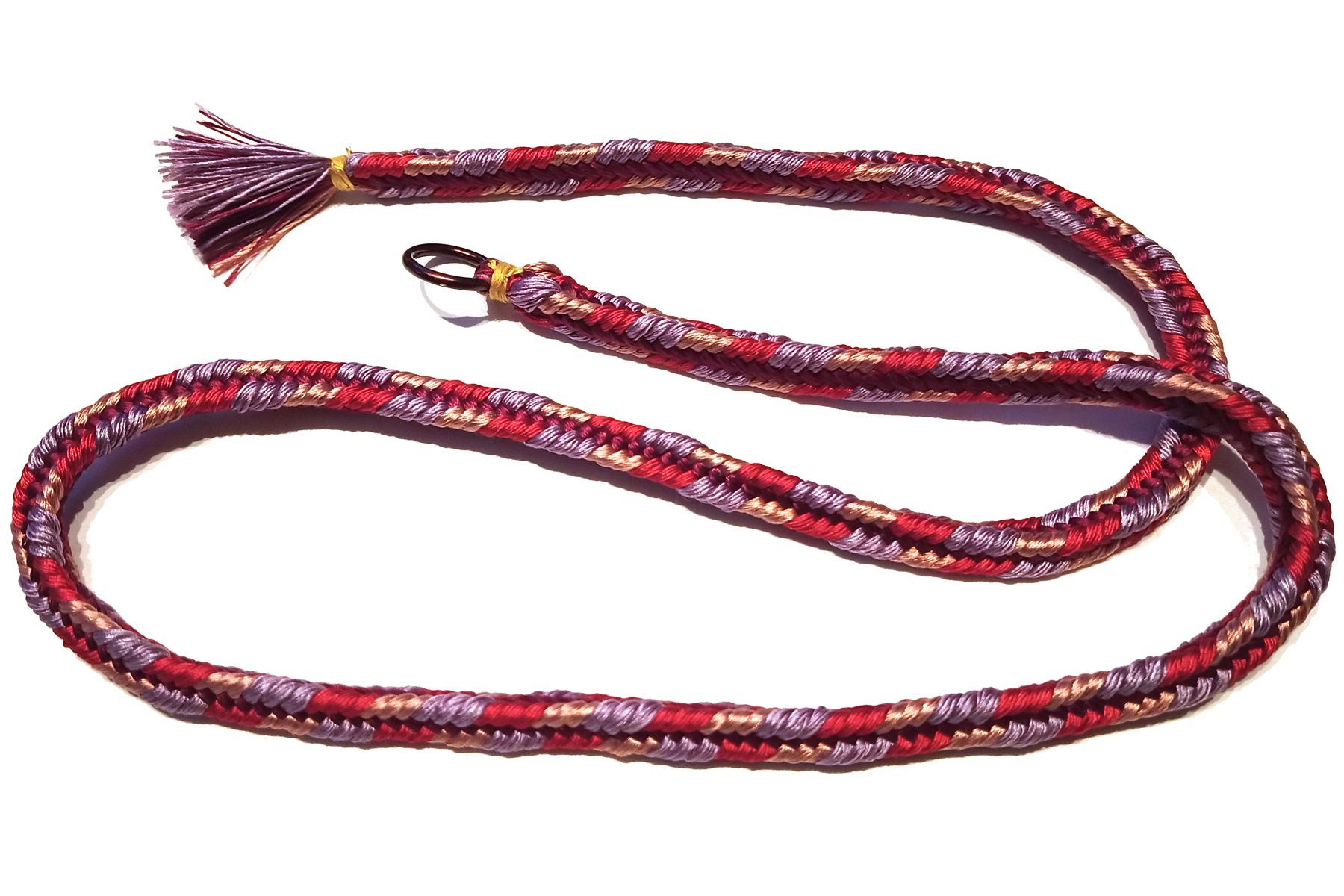
I still had a lot of burgundy and gray crochet cotton tripled up on my kowaku spools since last year. I was measuring out a lot of material for my class at the Braids 2025 conference in Cleveland, and it’s just been occupying the spools since then. I decided to use up as much of it as I could and make a nice, long shigeuchi braid on my sankakudai.

The final braid is about 9.5 feet long between the bindings and not quite a half inch wide. Each strand of this 9-strand braid has 6 ends of cotton crochet thread, and I started with 13 feet of material. So, about 27% uptake. The next sankakudai braid will be a sageo cord in dark blue silk, so these calculations are fairly important. I’m aiming for about 9 feet long.

bookmark_borderRainbow Cotton Takadai Braid

Started with 17 strands of cotton crochet cord in 9 different colors, 4 ends per strand about 116″. Had it on the takadai for about a month, working on it here and there, plain 1-1 interlacing. Finished it up this week while I have more free time. 76″ between the bindings, roughly 7/8″ wide.

17-strand Takadai Braid

I should do more braiding on the takadai. I did a bunch of braiding one morning, then the next day when I was getting dressed, I had a mysterious blister on my right index finger. I could not figure it out until I started braiding that day, and the beater sword bonked right up against the blister. Ow. Maybe I’ll get a kumishi callus.

I’ve already warped up the takadai for another braid.

bookmark_borderRainbow Sankakudai Braids

When the call went out before Pennsic for largesse items to be gifted to the East Kingdom, one of the suggestions was “rainbow” color schemes. I did all my braids in purple and gold to match East colors, but the rainbow idea stuck in the back of my mind. I later realized that as possibly the only person in North America to own a traditional Japanese sankaku-dai, I was maybe the only person in the SCA who could create braids in the classic 7-color “Roy G. Biv” (red, orange, yellow, green, blue, indigo, violet) rainbow pattern. Seven-strand braids are possible on other braiding stands, but they are fast and smooth on the sankakudai.

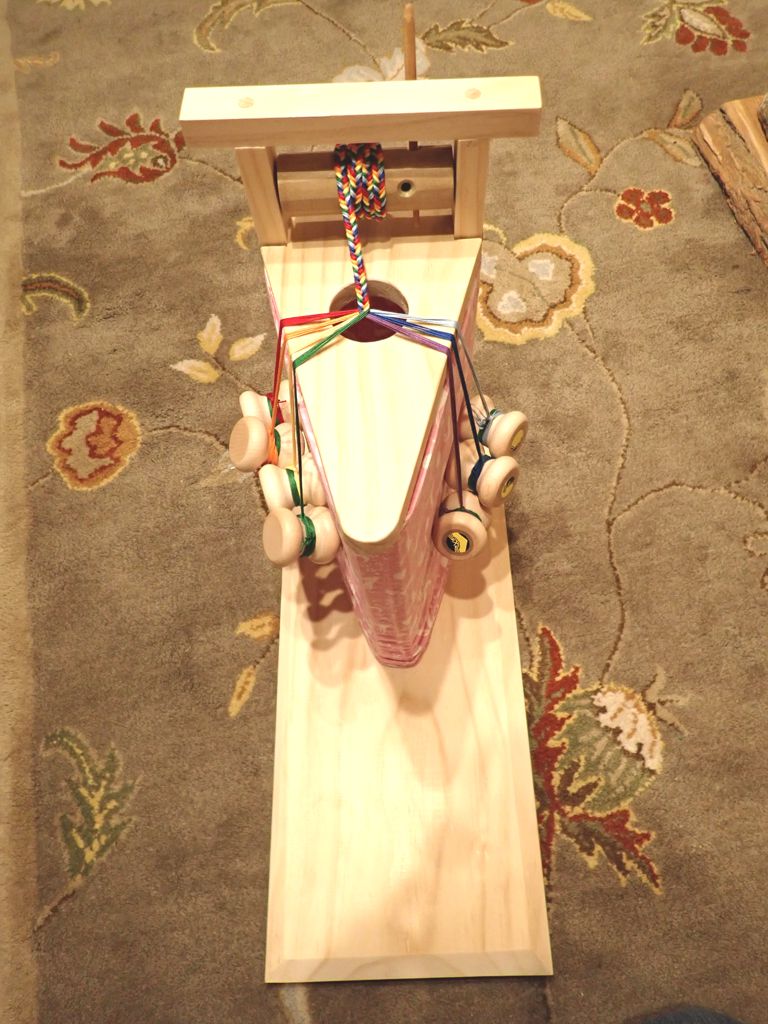
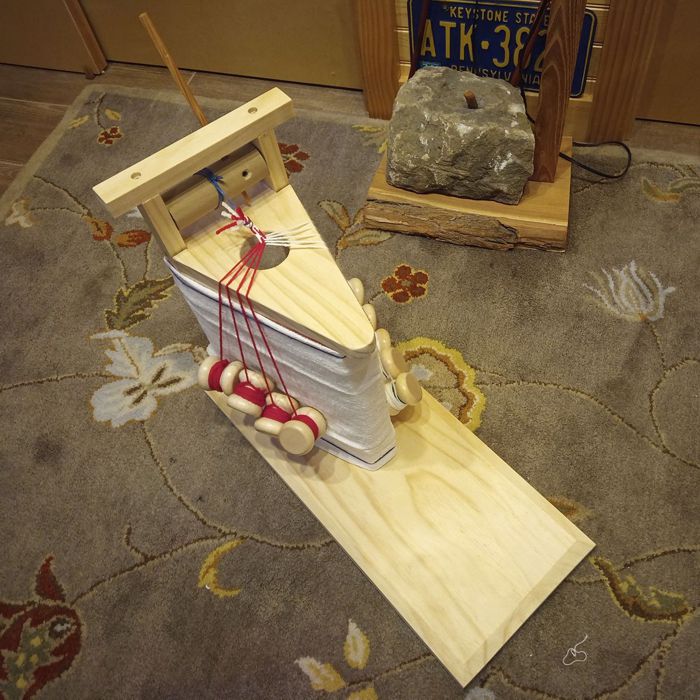
Sankaku-dai set up for 7-strand rainbow braid

To work a 7-set braid on the sankakudai, you lift the top strand on left, and move it over the other left-hand threads to become the bottom strand on the right. Then you do the same from right to left. When the point of braiding gets too close to the tip, use the roller to pull it back towards the torii. When the tama get too close to the mirror of the dai, extend them as you would on a marudai. You can add twist to the strands or not, as you please. I have found very little difference in the resulting braid, but that may be because of the material I am using.

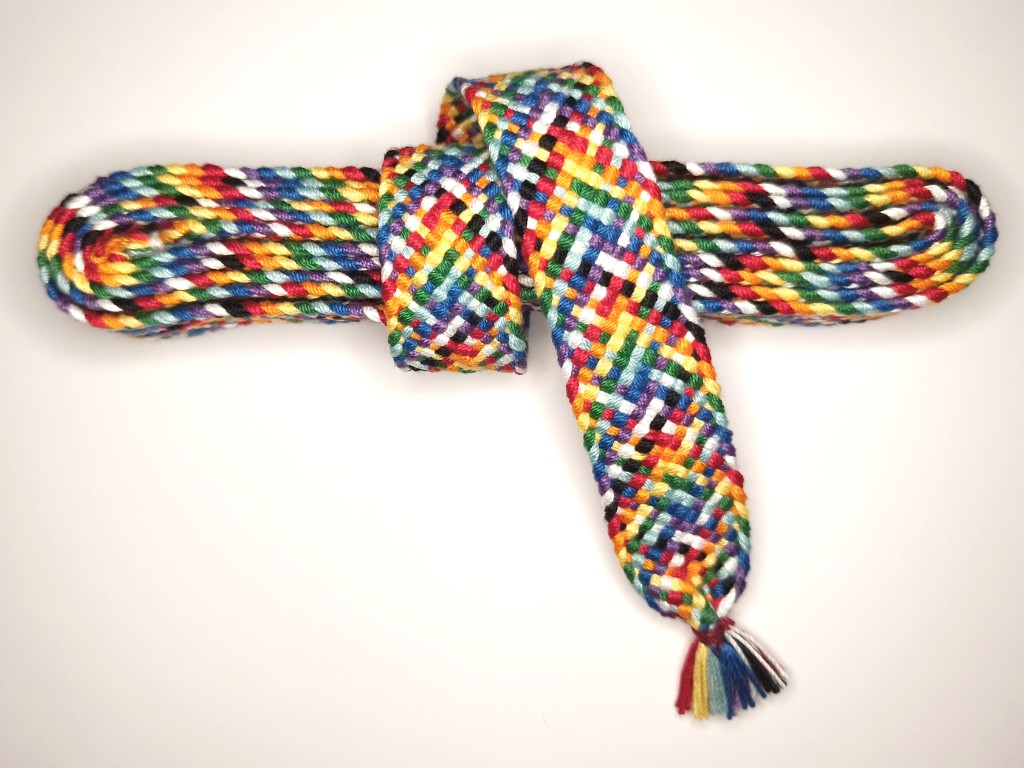
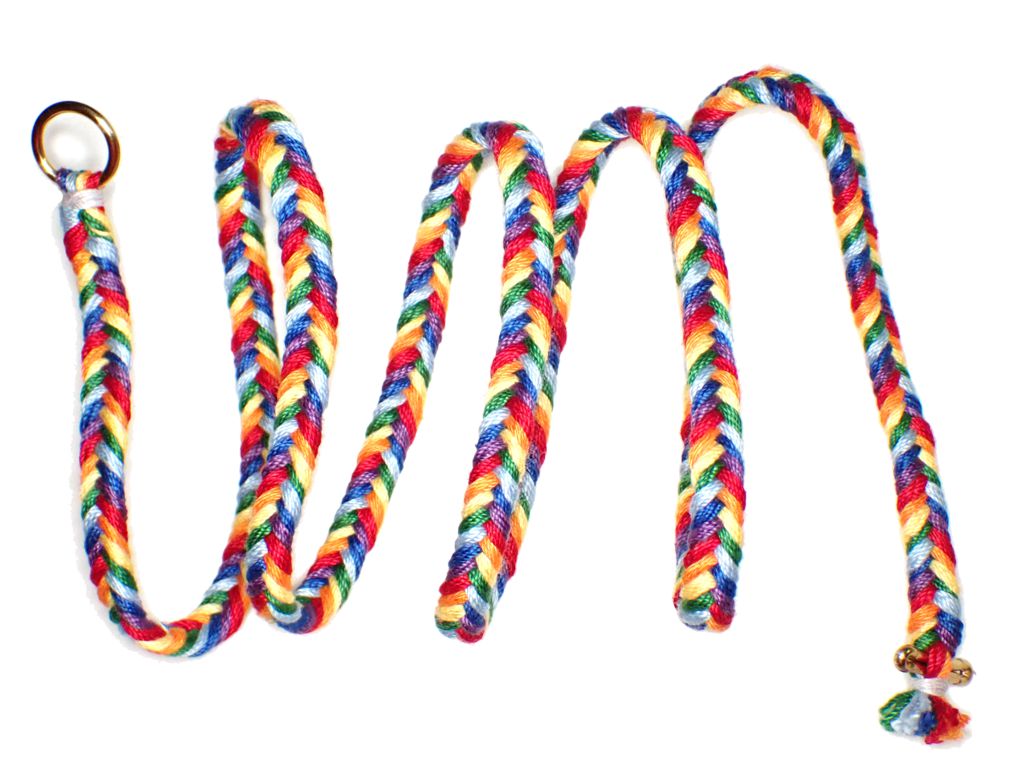
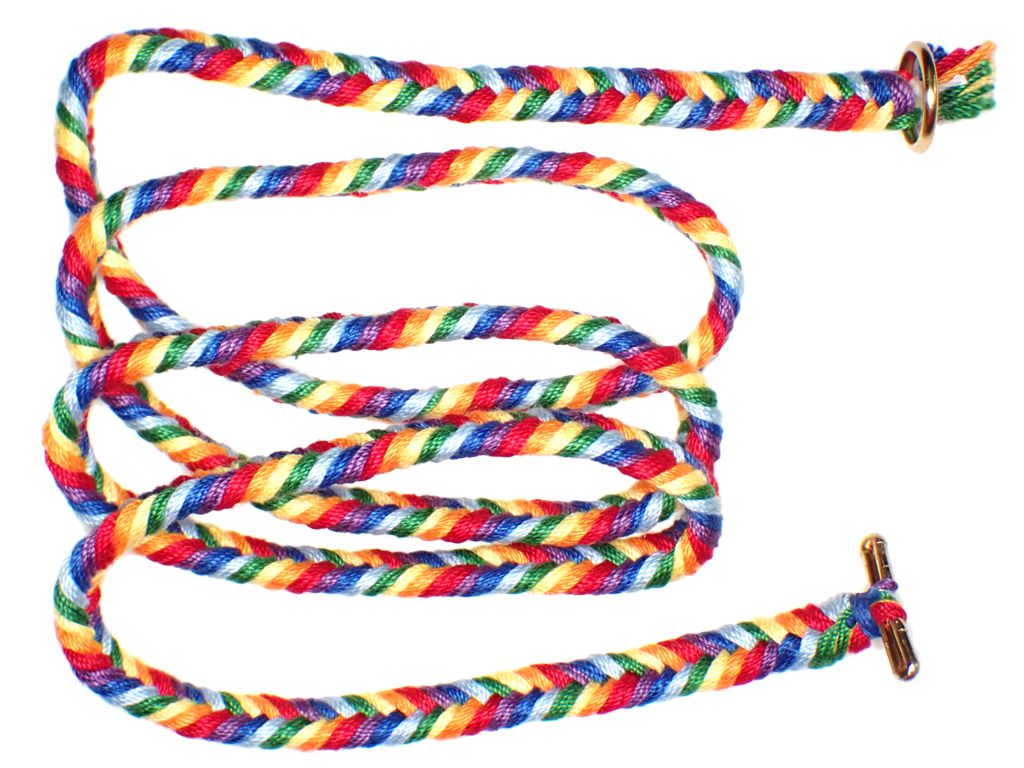
Here are the 3 rainbow braids I made in one evening on my sankakudai:

braid-20240821-1
Sankakudai 7-set rainbow braid,
8 ends of crochet cotton per strand
(twist applied)
braid-20240821-2
Sankakudai 7-set rainbow braid,
8 ends of crochet cotton per strand
(no twist)
braid-20240821-3
Sankakudai 7-set rainbow braid,
10 ends of crochet cotton per strand
(no twist)

Adding more ends per strand make a braid that is only a little wider, but much softer. I am really glad I tried this braid, and happy to add it to my repertoire. These braids are cheerful and friendly, and I know that people will enjoy receiving them.

bookmark_borderCoronation Largesse

I did my normal thing and made some belt favors and medallion cords for the Kingdom to celebrate the Coronation of Murdoch and Rioghnach. Twelve belt favors for some of the Kingdom awards, and six 8-strand braids for whatever they want. These will all go in the Barony’s gift basket to the Kingdom. Since the Coronation is today, I can talk about it.

bookmark_border3 Odd Braids in Silk

At the Braids 2025 conference in Cleveland, I am scheduled to teach a class on three braids for the marudai that use an odd number of elements. I realized that while I had a bunch of sample braids for those three, but none that I would consider to be “show quality”. They are mostly done in cotton or fuzzy yarn, and some of them have been attached to garments or other projects. to be “show braids”, they really should be done in silk thread and should be at least a couple of feet long. We still had plenty of reeled silk from the Georgia Yarn Company, so I decided to get busy braiding.

9-Strand “Shigeuchi Gumi” (30 inches)
17-Strand “Taka on Maru” Braid (32 inches)
15-Strand “Sankaku Gumi” (26 inches)

I braided each of these with about 16 ends of silk thread per tama. I say “about” because the lavender thread is ever so slightly thicker than the other colors. To get the 17-Strand braid relatively even, I had to go down to 12 ends of lavender pr tama. I had to work out the right patterns for each braid that would keep the colors together through the braid. That was somewhat tricky, but I now have a Jacqui Carey-style coloring grid for the 17-strand braid, which will be super handy in the future.

If any of these three braids interest you, please consider coming to the conference and signing up for my class! I am scheduled against some big names in braiding, so I would really appreciate support from the marudai braiding community.

bookmark_borderDifferent Double-Hira

Following up on the previous double-hira, which expanded the 8-strand flat braid to 16 strands by having 8 groups of 2 instead of 4 groups of 2, I decided to try the braid with 4 groups of 4. Here’s what the pattern looks like:

16-Strand “Double Hira” Gumi A

Note the asymmetrical first move. Here is what the braid looks like:

Double-Hira Gumi A in black and gold silk

I really like the look of this braid. Interestingly, the braid is much thicker along one edge than along the other. I just love the look of those zig-zag chevrons, and the stitches come out really tight.

I didn’t post a pattern for the previous double-hira, so here it is, for comparison:

16-Strand “Double Hira” Gumi B

It sure looks more confusing, but it’s the same moves, just with more groups.

bookmark_borderDelayed Baronial Regalia

Normally, I try to hand over these things by Agincourt, but with Baronial Investiture just weeks later I wound up holding off on presenting these until I could present them to the new Baronage.

First is this set of six silk braids I completed in September. These are all 8-strand marudai braids done in silk.

Second is this set of 8-strand marudai braids I completed in October. Some of these are done in silk, and some of them are done in this super-soft silk/alpaca blend yarn we bought back in January. I wanted to experiment and compare 3 ends of silk/alpaca yarn per strand to the 8 ends of lace-weight silk yarn per strand that I normally use.

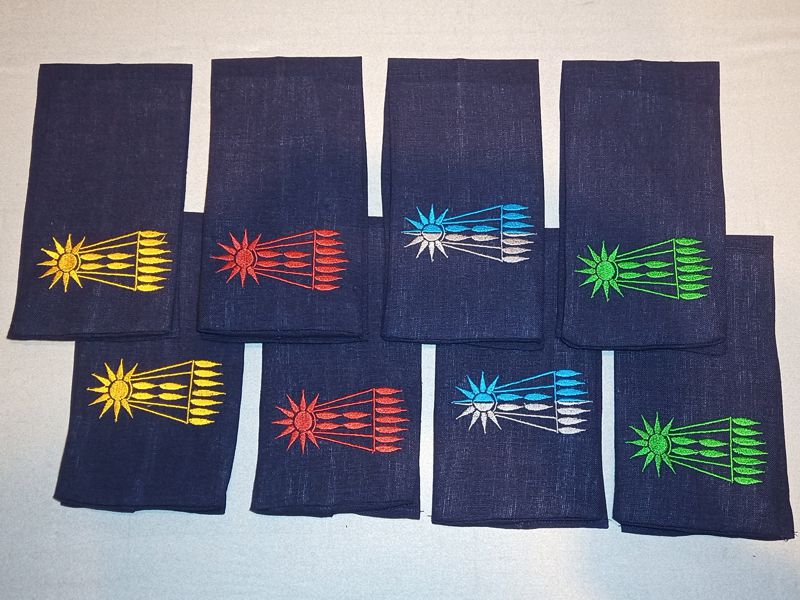
Finally is this set of eight machine-embroidered belt favors for the Baronial Comet awards. These apparently came in handy, as I saw several of them handed out later in the day.

bookmark_borderBaronial Braids for Agincourt

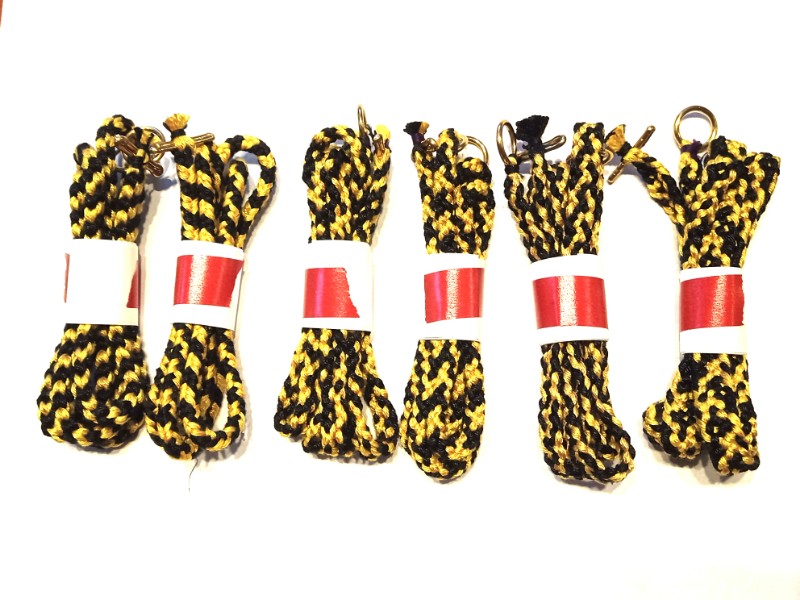
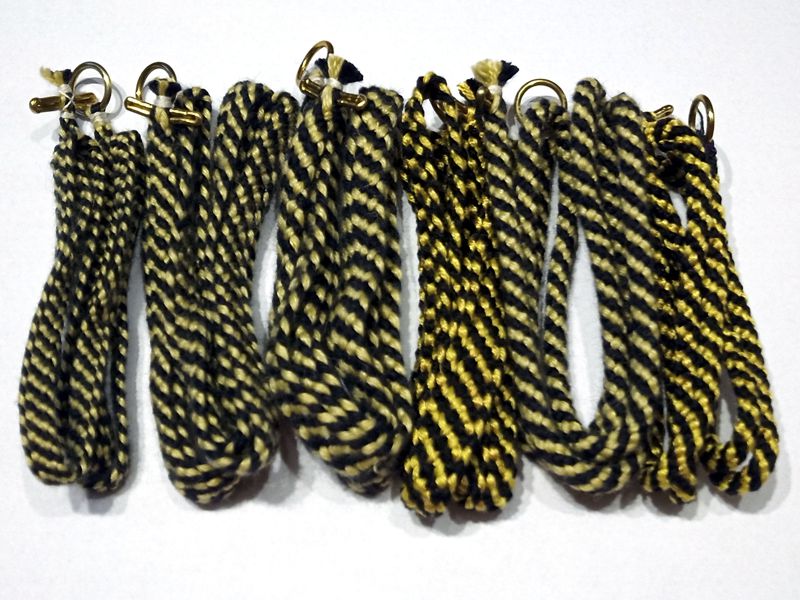
As is my tradition, I made some braided silk medallion cords to donate to the Barony at Agincourt. These braids are all 8-tama braids with 8 “ends” of lace weight silk yarn per tama. The braids are all standard 8-tama braids (kaku genji, kaku, shippou, Edo yatsu, yatsu se, shige uchi) with 4 tama of each color, and I set them all up with the same color positioning (KK GG GG KK) so that I could compare how the colors move through these different braids. I gave them my standard “ring and toggle” closures, and added a jump ring for any medallion.

Six silk braids for Agincourt

This is the last Agincourt for our current Baronage, so I’m not sure that they will need all of these cords themselves, but I’ll make more for the next Baronage anyway.